Introduction
Mauritania is an Arab and African country with several ethnic groups; most of the inhabitants of the South and South-East do not speak Arabic. Despite this ethnic diversity, its whole population is Muslim and united by the Maliki school. Colonization sought to exploit ethnic and communal divisions to serve its expansionist aims: it focused on the Black African population, whose elites became steeped in French language and culture.
In the early 1980s, ethnic unrest broke out between Arabs and Black Africans, fuelled by propaganda and racist rhetoric. These events had serious consequences: they deepened the social divide and created strong racial tensions.
In this context, the country’s people of goodwill and peacemakers had to act to meet these great challenges and bridge the deep gap that threatened the very existence of the State and society, and raised fears of division and devastating civil wars. This is how the idea of founding the Institute was born: to build long-term work that strengthens the social fabric and brings together the components of society according to the teachings of Islam, by making Arabic the official language of all members of society.
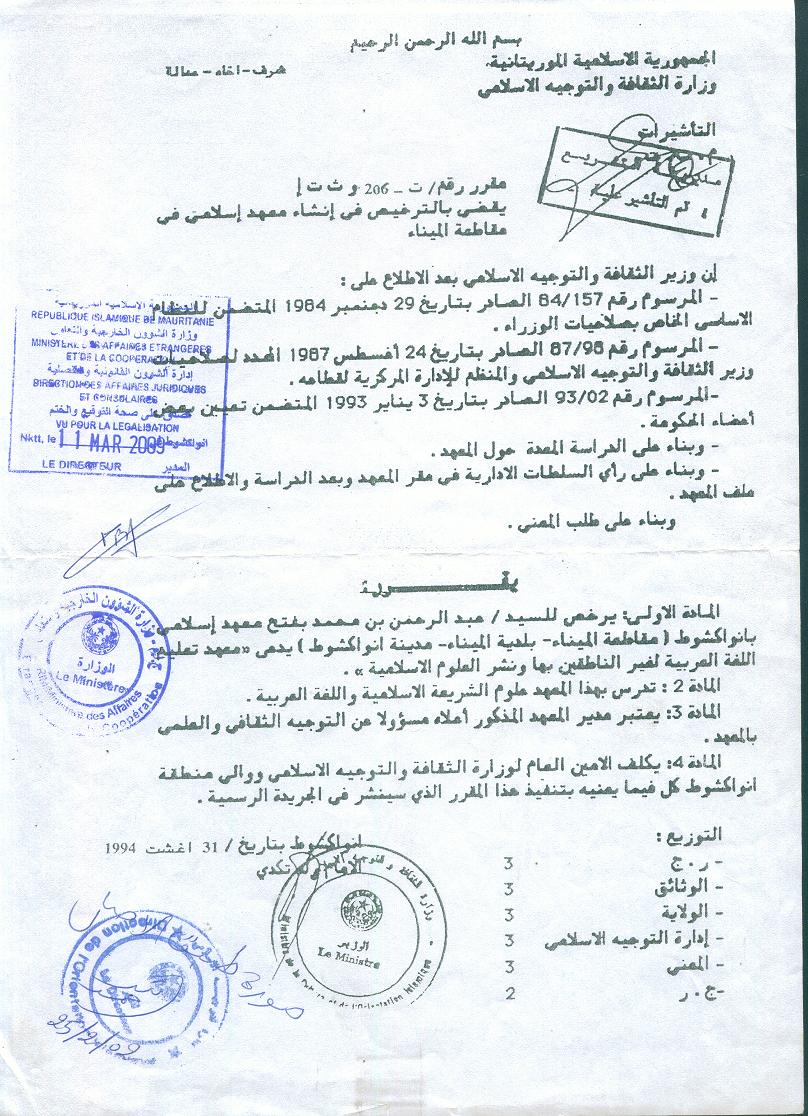
The Institute for Teaching Arabic to Non-Native Speakers and Spreading Islamic Sciences was authorized by the Ministry of Culture and Islamic Orientation under number 206 on 31/08/1994. It actually began its activities in 1997. Despite scarce resources and modest means, the Institute has made great progress towards its goals:
- Teaching Arabic to non-native speakers: as the language of the Quran and the official language of the country, it can replace French, which has become the common language of Black Mauritanian intellectuals.
- Spreading Islamic sciences: ignorance of the foundations of the religion is widespread among non-Arabic speakers, especially regarding the Quran, Islamic law (fiqh) and the biography of the Prophet.
- Contributing to literacy, as most of the inhabitants of the region cannot read or write.
- Contributing to safeguarding and preserving heritage, as these communities have a recognized cultural heritage in the country.
The Institute focuses its presence on the following regions:
- the capital, Nouakchott;
- the wilaya of Brakna (250 km south-east of Nouakchott);
- the wilaya of Trarza (205 km south of the capital);
- the wilaya of Gorgol (370 km south-east of the capital);
- the wilaya of Guidimakha (800 km south-east of the capital);
- the wilaya of Hodh El Gharbi (800 km east of the capital).
These regions are among the most targeted in the country by Christian missionary organizations. They therefore greatly needed such efforts, which keep them attached to their religion and values and connect them to their Islamic roots, especially since language remains an obstacle for many. As this population is also, for the most part, among the poorest in society, the Institute carries out social and charitable activities that support its mission and strengthen the bond between students, beneficiaries and the Institute.
The Institute’s main areas of work
- Regular education: permanent classes teaching the Holy Quran, the Arabic language and religious sciences.
- Arabic courses for non-native speakers.
- Founding Quranic mahadras and memorization circles.
- Literacy programs.
- Support for mahadras.
- Training for imams and preachers.
- Teaching tours.
- Social and charitable work (Eid clothing, distribution of sheep for Eid al-Adha…).
The Institute also seeks to introduce technical training into its programs (computing, electricity, carpentry…).
1. Teaching in permanent classes
These classes teach the Holy Quran, the Arabic language and religious sciences according to a set curriculum. This year they welcome 947 students, plus more than 526 students in mahadras supported by the Institute, making 1,473 students in all, in the areas where non-Arabic speakers are most numerous:
- the capital, Nouakchott (moughataas of El Mina and Sebkha);
- the wilaya of Brakna (Boghé, Ouabounde, Dioudé, Mbagne, Dar Salam);
- the wilaya of Trarza (Rosso, Dar El Barka, Sawab);
- the wilaya of Hodh El Gharbi, in the far south-east (Achouïf);
- in addition, mahadra classes (Quranic schools) teach the Holy Quran and religious texts with the traditional method.
The following table shows how students are spread across these regions:
| Nouakchott | Brakna | Trarza | Hodh El Gharbi | Total |
|---|
| 386 students | 435 students | 375 students | 277 students | 1,473 students |
2. Quran memorization circles
At dedicated times, these circles allow adults and children who cannot attend the Institute’s classes to memorize the Holy Quran, following a set program and the rules of recitation (tajwid and tartil). So far, 1,285 men and women have benefited. Each year the Institute runs twenty circles of 20 to 35 students each.
- Number of circles: 20
- Number of teachers: 20
- Length of a circle: 10 months
3. Arabic courses for non-native speakers
These courses are for non-Arabic-speaking professionals, intellectuals and students. Following a set program, they offer varied lessons in reading, writing and the sciences of the Arabic language, as well as the basics of religious sciences. So far they have trained 1,330 men and women, including doctors, primary school teachers, teachers and civil servants, and they have spread to some neighbouring countries. These courses have produced good results and have helped many non-Arabic speakers learn Arabic. The Institute runs five a year in the country, in addition to those held in neighbouring countries. Demand grows every year: a class has 20 learners on average.
4. Literacy classes
These classes teach illiterate adults to read and write, along with essential rules such as purification and prayer, according to a set program. Despite their importance and the great need they meet, especially in rural areas where illiteracy is high, they still attract few people, out of embarrassment and for lack of incentives. More than 215 people, mostly women, have benefited so far.
5. Teaching tours
These tours are led by qualified teachers and imams, following a program on the foundations and principles of prayer and purification, and on some important rules such as those of funerals. They have already covered many villages and towns along the river:
- Trarza and Brakna: Rosso, Tékane, Keurk, Keur Macène, Guidakar, Jidr El Mohguen;
- Brakna: Boghé, Ouanabina, Dioudé, Bababé, Dar El Avia, Ouabounde…;
- Hodh El Gharbi: Achouïf, Boulkedour, Idir, Bou Nouara, Tachout, Berjène…
Length of a tour: one week to one month. Number of tours: 15 to 20 a year.